A Journey Built in Stages
My aviation journey has not followed a single straight line. It has developed through education in the United Kingdom, early aviation exposure in Southampton and Al Khor, formal training in San Diego, commercial and multi-engine progression in Ontario, and a current professional chapter in East Africa. Each place contributed something different, and together they shaped how I approach preparation, responsibility and continuous learning.
The record is best understood through specific facts. My licences, ratings and logged hours show a developing commercial-pilot career shaped by several training environments and a commitment to keep building sound professional foundations.
Technology and Early Assessment in the United Kingdom
Most of my education was completed in the United Kingdom, where I progressed through school and college and earned a diploma in Information and Technology. That background encouraged a systems-based way of thinking: understand how the parts connect, organise information clearly and use technology to make complex material more accessible. Those habits continue to support both my aviation study and my interest in aviation education.
My first structured exposure to aviation included pilot aptitude and psychometric assessments at an approved training organisation in Southampton. The experience introduced the cognitive demands of pilot training and made the path more concrete. It was an early opportunity to understand that aviation requires more than enthusiasm; it requires preparation, self-awareness and a willingness to be assessed against clear standards.
Introductory Flying in Al Khor
The next step was introductory flying in Al Khor, Qatar. It moved aviation from assessment and theory into a practical environment. Being in and around the aircraft gave context to subjects that can otherwise feel abstract: the relationship between preparation and execution, the importance of clear communication and the need to stay aware of what is happening beyond a single instrument or task.
Introductory experience is only a beginning, but it can establish the right questions. What does disciplined preparation look like? How should a pilot divide attention? How do procedures support rather than replace judgement? Those questions remained relevant as my training later became more formal and technically demanding.
FAA Training in San Diego
From 2015 to 2016, I trained at California Flight Academy in San Diego. I earned an FAA Private Pilot Licence for Single Engine Land aircraft in 2015, followed by an FAA Instrument Rating for Single Engine Land aircraft in 2016. Private-pilot training developed the practical foundations of aircraft handling, planning and pilot-in-command responsibility.
Instrument training added another layer. It required a disciplined scan, accurate interpretation of information, procedural consistency and active workload management. It also reinforced an important lesson: staying ahead of an aircraft is largely a product of preparation and prioritisation. When the workload rises, a stable process creates the capacity to notice change and make a measured decision.
Commercial Training in Toronto
I later continued my development in Canada at Canadian Flight Academy in Toronto during 2022 and 2023. In 2022, I earned a Transport Canada Commercial Pilot Licence for Single Engine Land aircraft. Returning to structured training in a different country and regulatory environment required adaptability, but the core expectations remained familiar: know the standard, prepare thoroughly, communicate clearly and accept constructive feedback.
The commercial stage placed greater emphasis on consistency and professional responsibility. A manoeuvre or planning task was not simply something to complete once; it needed to be performed within a repeatable process. That distinction continues to influence how I think about professional development. Progress is strongest when knowledge and skill can be applied reliably, not only when conditions are ideal.
Multi-Engine and Instrument Development in Burlington
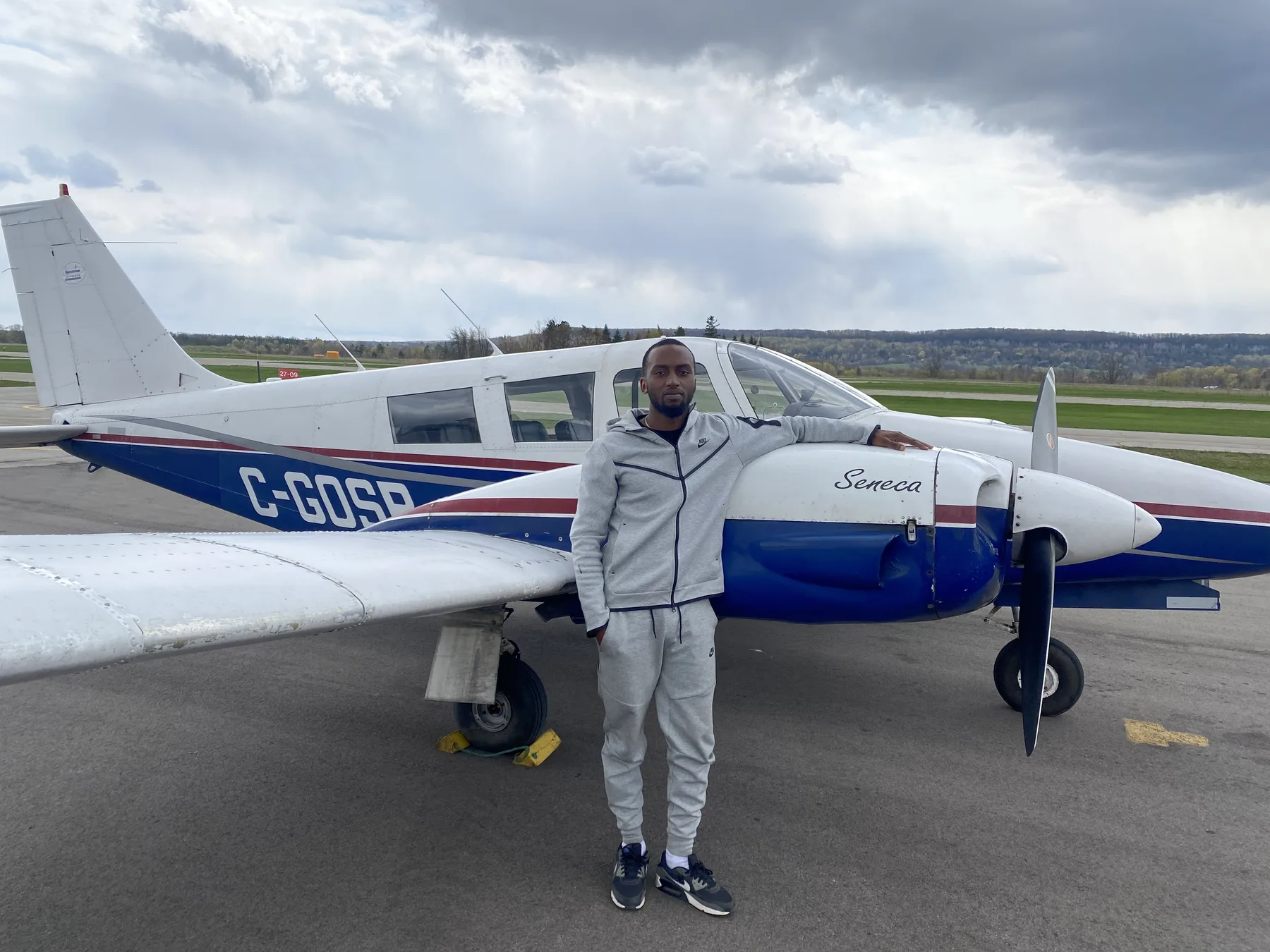
In 2023, I trained at Spectrum Airways in Burlington for the Transport Canada Multi-Engine Rating and Instrument Rating. Aircraft experience from the journey includes the Cessna 172, Piper Seneca and Piper Seminole. Moving into multi-engine training increased the pace and complexity of the workload.
That stage reinforced the value of prioritisation, cockpit organisation and clear communication. Multi-engine and instrument work demands that a pilot understand what matters immediately, what can wait and how one action changes the options available next. By April 2026, I had logged more than 260 total flight hours, including pilot-in-command, cross-country, instrument and night flying.
The Current East African Chapter
I have since relocated to East Africa. My current development includes being assessed for a First Officer position on the Bombardier CRJ900. It remains an assessment stage as I prepare for the next chapter of commercial aviation work.
My licences and ratings include an FAA Private Pilot Licence and Instrument Rating for Single Engine Land aircraft, a Transport Canada Commercial Pilot Licence and Instrument Rating for Single and Multi Engine Land aircraft, and a UCAA Commercial Pilot Licence and Instrument Rating for Single and Multi Engine Land aircraft. They provide a foundation for continued development, not a reason to overstate where the journey currently stands.
Bringing Aviation and Technology Together
Alongside aviation, I am developing a digital platform intended to make theoretical aviation learning clearer, more accessible and more effective. The project brings together my Information and Technology background with the experience of learning aviation subjects across different countries and regulatory settings.
The platform remains in development. Its purpose is practical: help learners build understanding rather than simply memorise isolated answers. That direction reflects the broader theme of my journey so far. Whether the setting is a classroom, a light-aircraft cockpit, a simulator or a professional assessment, meaningful progress comes from connecting knowledge to disciplined action.
Continuing With Accuracy and Purpose
Aviation development is cumulative. The UK technology foundation, Southampton assessments, introductory flying in Qatar, FAA training in California, Canadian commercial and multi-engine progression, and the current East African chapter each form part of one story. None should be inflated beyond what it represents, and none needs to be. The progression is credible because it is specific.
My direction is to continue developing as a commercial pilot and aviation professional while contributing to better aviation learning. The priorities remain preparation, adaptability, responsibility, safety, teamwork and honest reflection. Those principles provide a clear foundation for the work still ahead.